 Check PH · Independent guide
What happens when you press Play?
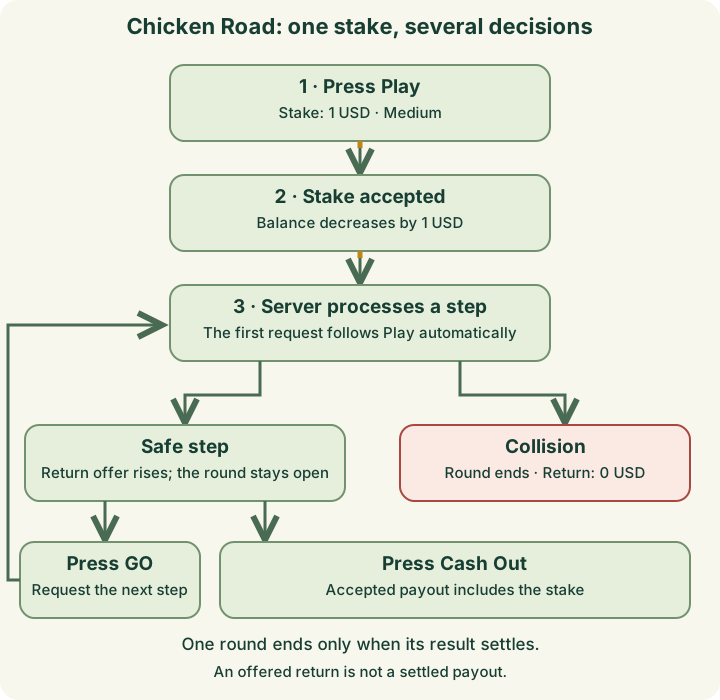
Chicken Road’s visible road is the interface to a sequence of server-confirmed decisions. In the original INOUT demo we inspected, Play first submits the amount, currency and selected difficulty. When the stake is accepted, the balance decreases. The browser then requests the first step automatically. You do not get a separate pause between committing the stake and attempting that first crossing.
A safe step returns a multiplier and an offered payout while leaving the round unfinished. At Medium’s first step, our 1 USD stake had a 1.12 USD offer. That was not an extra 1.12 USD already added to the balance. Pressing GO requested the next line and kept the same stake in play. The client did not debit another stake for every successful step.
There are two ordinary endings in this sample. A collision returned a finished, losing state and no payout. An accepted Cash Out returned a finished, winning state and credited the settled return. Our chosen target was five safe steps, corresponding to 1.98× in the captured configuration. A successful cashout therefore returned 1.98 USD, including the original 1 USD; the winning-round profit was 0.98 USD.
This distinction matters when the animation and numbers move quickly. A possible return, a credited payout and a profitable whole session are three different things. The game’s action named withdraw is the in-game cashout operation. It does not send money to GCash or a bank. That later account transaction belongs to the operator and is covered in the cashout and withdrawal guide.
The four difficulty modes use different multiplier ladders
The client receives its multiplier tables and bet limits from the game service. Those values are not a probability table. They tell the browser what return to show at each available step, but they do not, by themselves, prove the probability of reaching that step. We saved the configuration separately from the observed outcomes so that a later client update cannot silently change what our sample means.
| Mode in the interface | Listed lines | First five multipliers |
|---|---|---|
| Easy | 24 | 1.03× · 1.07× · 1.12× · 1.17× · 1.23× |
| Medium | 22 | 1.12× · 1.28× · 1.47× · 1.70× · 1.98× |
| Hard | 20 | 1.23× · 1.55× · 1.98× · 2.56× · 3.36× |
| Hardcore | 15 | 1.63× · 2.80× · 4.95× · 9.08× · 15.21× |
The interface calls the fourth difficulty Hardcore; the captured configuration uses DAREDEVIL as its internal name. That is a mapping inside this original client, not another game edition. The number of listed lines also comes from the current in-game help. Keep it separate from a promotional screenshot or a rule copied from Chicken Road 2.0.
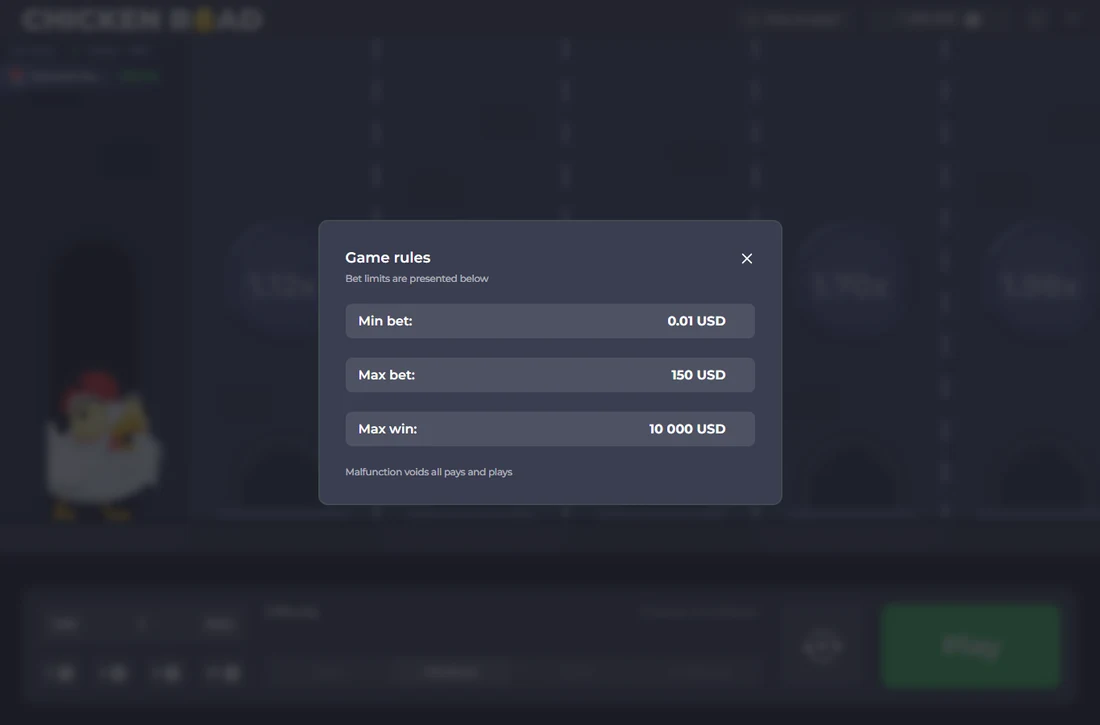
Our USD demo’s rules window and configuration agreed on a 0.01 USD minimum stake, 150 USD maximum stake and 10,000 USD maximum win. The default amount was 3 USD, with shortcuts for 2, 3, 8 and 20 USD. We deliberately changed the research stake to 1 USD. These are recorded demo values, not universal limits promised for every operator or currency. A large advertised multiplier does not remove the current payout cap.
INOUT’s original-game page publishes 98% RTP. That is a theoretical returned-value claim, not a promise that 98 out of 100 attempts win. In our short sample, 50 USD of stakes returned 35.64 USD: an observed return of 71.28% and a net result of −14.36 USD. Fifty rounds cannot validate or overturn the long-run RTP. The two percentages answer different questions and should not be presented as interchangeable measures.
A second common confusion is “2×” versus “two steps.” On this Medium ladder, two successful steps offer 1.28×; five offer 1.98×. A rule asking for exactly 1.50× also needs clarification because that value is absent from the first five steps. Choosing 1.47× or continuing to 1.70× changes the decision. The strategy comparisons spell out the actual targets instead of treating rounded labels as buttons.
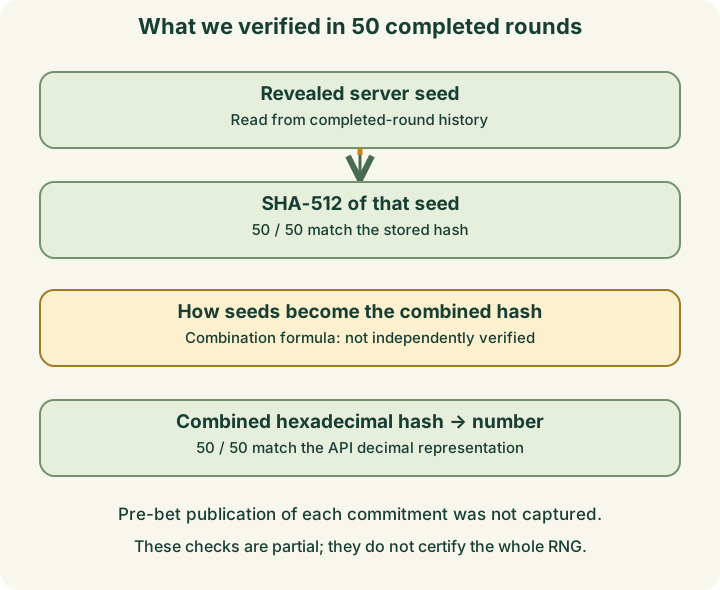
What passed when we checked all 50 recorded rounds?
The first test is accounting. For each round, we checked opening balance minus accepted stake plus settled payout against the next balance. All 50 reconciled, with no breaks between consecutive rounds. There were 18 successful cashouts and 32 collisions. The opening virtual balance was 1,000,000 USD and the closing balance 999,985.64 USD. Those large demo balances are not deposits or withdrawable money.
The game’s My bet history returned 50 completed entries. Every stake and payout matched our chronological record. That comparison used order and amounts because the ordinary step replies did not expose the same history ID. Server timestamps were about 67 seconds ahead of local request-capture time; we checked that offset rather than mislabelling it as a slow response. The history’s creation timestamp also belongs to the start of the bet, not the end of its animation.
The history exposes a revealed server seed, client seed, combined hash and stored server-seed hash. Independently calculating SHA-512 of each revealed server seed matched its stored hash in all 50 entries. Converting each combined hexadecimal hash to the floating-point numerical representation used by the API also matched all 50. The decimal is an approximate scientific-notation representation of a very large integer, not a precise full-length integer string.
Those two checks have specific limits. We did not capture the commitment before each of these bets. Agreement between values revealed after a round does not independently prove when the commitment was published. We also have not reproduced the exact combination of seeds into the combined hash or the complete mapping from that hash to the game outcome. A correct seed hash must not be promoted into a claim that every stage of the RNG has been audited.
The visible fairness help deserves a careful reading. Its next-seed label says SHA256, while the observed hash field contains 128 hexadecimal characters and all 50 historical commitments match SHA-512. The help also refers to the first three bets of a round, although this sample consists of single-player, one-stake rounds. We record these inconsistencies as interface findings; they do not by themselves prove manipulated results.
The server supplied collisionPositions only when a round finished. All 50 terminal responses contained three positions in this Medium sample. In the 32 losses, the earliest disclosed collision matched the attempted line. In the 18 cashouts, it lay beyond the line where we stopped. None of the 145 unfinished safe-step replies contained that field. This is post-settlement information, not a signal available before the next step.
We preserve that disclosed layout as a separate kind of evidence. It does not turn an unplayed sixth step into an observed sixth-step result. Comparisons of earlier exits can use the path we actually saw up to step five. Claims about later continuation need an independently established rule for interpreting the disclosed layout. That separation prevents a retrospective chart from quietly becoming a fictional play session.
Where do the Live wins cards and Online count come from?
The top-left Live wins card receives updates from the provider’s server through a WebSocket event named gameService-last-win. The message contains a username, country code, win amount and currency. The loaded client assigns those values to the card; an initial last-win value can also arrive with the game configuration. We matched one visible +$420.00 card to the corresponding received message.
This establishes where the display gets its data, not whether each entry represents a real-money customer. The message does not contain a stake, bet ID, event timestamp, demo/real flag or withdrawal receipt. The stream can therefore not be used to calculate other players’ profitability, verify a payment or establish a complete history of losing and winning attempts. During a saved one-minute window, we received 19 updates with a median interval of about 3.12 seconds.
The Online figure follows a different path. The client requests a counter approximately once per minute, selects the Chicken Road field, multiplies it by 1.7 and rounds it. In the captured example, the server value was 635 and the displayed number was 1080. The display was therefore about 70% above that source field. We have not established the definition of the underlying count, so neither number is presented here as an independently verified total of unique human players.
These are findings about the saved original-demo build. They should not be generalised to every INOUT title or every operator integration. For a practical decision, do not treat a busy-looking counter or an impressive neighbouring win as evidence that your next step is safer. Your own settled history is the relevant record for stake, payout and session net.
How fast did the game service answer?
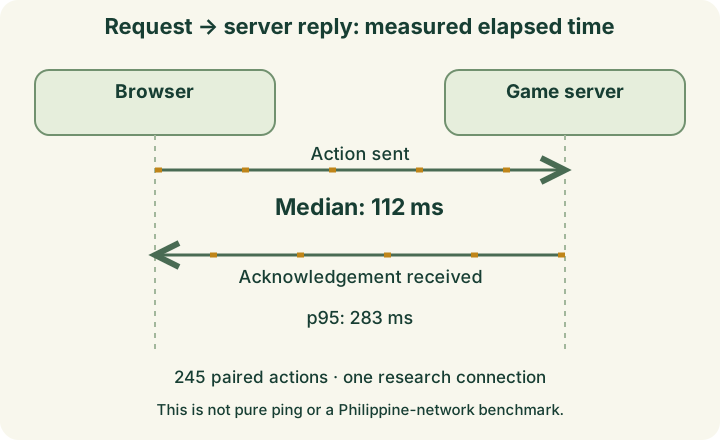
The timing sample was recorded on 3 November 2026 in CloakBrowser on Windows, from one research connection. We paired 245 game-action requests with their acknowledgements using the same local capture clock. The overall median elapsed time was 112 milliseconds; the 95th percentile was 283 milliseconds. Those measurements include the network journey, server work and local browser scheduling. They are not a pure network ping and do not promise the same experience on a Philippine mobile connection.
| Action | Paired replies | Median elapsed | 95th percentile |
|---|---|---|---|
| Accept stake | 50 | 132.5 ms | 283 ms |
| Attempt a step | 177 | 97 ms | 312 ms |
| Settle cashout | 18 | 188.5 ms | 337 ms |
The difference between response time and animation time explains why rapidly repeated taps are not a sound measurement of game speed. A reply can arrive while the chicken is still moving, and the controls can remain busy until the interface finishes its transition. Our sample was deliberately sequential and included screenshot recording. It is not a maximum-throughput test.
The shared client code contains a separate latency-test command whose helper divides elapsed round-trip time by two. We found that code but did not invoke the diagnostic event. Half a round-trip is only an estimate of one-way delay; the two directions and server processing need not be equal. The figures above come from actual game actions instead.
Other ordinary commands load the current game state, configuration, bet history and fairness information. The delivered build also references avatar changes, promotional/free-bet notifications and shared lobby or tournament features. A name in the script is not proof that a feature is enabled in this demo. We used the public interface and did not activate debug controls or modify outcomes. For practical controls, continue with the illustrated how-to-play guide or the original demo page.
What the browser can show after a delayed reply
The browser and server do different jobs. The client displays the road, accepts an input and presents the reply. The server acknowledgement supplies the observed step state and result. A delayed visual effect is not a second stake, and a frozen frame is not sufficient evidence of a collision. The meaningful question is whether the accepted action has a final state and how it changed the balance.
The ordinary client also requests the current game state. Our initial empty state arrived as the string “null,” which the client normalised; it was not a finished losing bet. That is a small but useful example of why copying a raw field without reading its context can produce a wrong explanation. History entries, open-state replies and terminal replies have different purposes.
For an interrupted session, retain the accepted stake, last known state and any accessible history entry. Do not manufacture a win or loss to fill a missing result. Our 50-round sample has no unresolved attempts in its final balance chain, but that successful accounting check does not guarantee that every future connection will behave identically.
What arrived during five minutes without placing a bet?
A separate passive recording on 3 November 2026 captured 136 WebSocket frames: 120 received and 16 sent. All frames were decoded. This session placed no bets, so it adds no rounds to the 50-round study. The connection delivered initial balance, bet ranges, bet configuration, demo profile fields and a currency table, followed by repeated Live wins updates.
The client sent three gameService requests: get-game-config twice and get-game-state once. All three acknowledgements were matched by their IDs. A state reply arrived before an earlier configuration request completed, which is why response order alone is not a reliable match. The initial state was null; it did not describe a losing round.
There were 98 gameService-last-win events, with a median interval of 3.094 seconds. Their messages contained a username, country code, amount and currency. They still supplied no stake, round identifier, demo/real flag or payment receipt. These broadcasts are separate from the current player’s complete betting history.
The transport exchanged 12 ping/pong pairs. Its handshake specified a 25,000 ms ping interval and a 20,000 ms timeout. This heartbeat checks whether the connection is alive; it is not a game result or a complete measured network round trip. The Online counter used six separate HTTP responses during the observation, not a WebSocket event.
The currency message contained 189 numeric entries. In the loaded client, these feed a conversion helper that divides an amount by its source-currency factor and multiplies by its destination factor. This is client display behaviour, not proof that all 189 currencies are available for bets or withdrawals. No hidden method or debug action was invoked.
Chicken Road: quick answers
Is Chicken Road controlled by the animation?
The inspected client requests step results from the game service and renders the returned state. We did not find evidence that tapping rhythm or visible traffic reveals a future safe step.
Did all 50 results pass a full cryptographic audit?
No. All balances and recorded history amounts matched. Revealed-seed SHA-512 hashes and the reported hash-to-number conversion matched in all 50 rows. The complete seed-combination and outcome-mapping algorithm, and pre-bet commitment publication, remain unverified.
Can the API show the next collision before I play?
No such response was observed. The collisionPositions field appeared only after settlement in this sample. The current fairness menu exposes a hashed server seed, not a revealed future seed.
We watched 1,127 Chicken Road winner messages
One hour, 274 displayed names and 375 repeated records. Search every observed name and amount, inspect the timing chart and see what the feed leaves out.