 Check PH · Independent guide
What a Chicken Road strategy can actually specify
A usable strategy must tell you what to do before a result is known. “Win more” is not a rule. “Use the same stake, choose one difficulty and take the first available multiplier at or above 1.50×” is a rule that somebody could follow and record. Whether it makes money is a separate question. You need the actual outcome history or verified probabilities to answer that question honestly.
The seven approaches below cover different decisions. Some change when the round ends; others change how much is exposed or when the session stops. Combining them without naming each component creates confusion. A small fixed stake with an early exit is not the same approach as a doubled stake with the same exit. Keep difficulty, amount and target in separate columns when comparing results.
| Rule | What you actually do | What it controls |
|---|---|---|
| 1. Fixed-step exit | Choose a step count before starting; cash out there if reached. | How many advances you attempt. |
| 2. Multiplier target | Take the first offered multiplier at or above your target. | The successful payout target. |
| 3. Fixed stake | Repeat the same amount for each new attempt. | Money exposed per round. |
| 4. Bank percentage | Calculate a stake as a chosen fraction of the current bank. | Exposure relative to remaining funds. |
| 5. Capped doubling | Raise the next stake after a loss, up to a preset cap. | Stake progression and its maximum. |
| 6. Stop-loss / take-profit | Stop new rounds after a preset net threshold. | Session length and exposure. |
| 7. Fixed practice block | Play a set number of demo attempts and record all of them. | A reviewable learning sample. |
These are seven rules to understand, not seven systems certified to win. We completed 50 original-demo rounds at a fixed 1 USD stake, with a preselected five-step exit. The measured result and earlier-exit calculations appear below. Seven decision rules are explained here; this does not claim seven independently played experiments.
50 actual rounds: what changed at earlier exits?
We played 50 completed rounds in the original INOUT demo on 3 November 2026. The rule was selected before the sample: Medium, a fixed 1 USD stake, and cashout after five safe steps at 1.98×. There were 18 cashouts and 32 collisions. Stakes totalled 50 USD; settled payouts totalled 35.64 USD. The whole session ended at −14.36 USD.
| Exit after step | Multiplier | Successful paths / 50 | Net (USD) |
|---|---|---|---|
| 1 | 1.12× | 41 | −4.08 |
| 2 | 1.28× | 33 | −7.76 |
| 3 | 1.47× | 29 | −7.37 |
| 4 | 1.7× | 24 | −9.20 |
| 5 | 1.98× | 18 | −14.36 |
Only the five-step policy was actually played. The first four rows recalculate earlier cashouts on the same observed paths; they are not four additional sessions. None of these five fixed exits made a profit on this sample. The one-step calculation lost the least, but selecting it after seeing these results does not make it a verified best strategy. Later steps after the actual cashout were not played and are not counted.
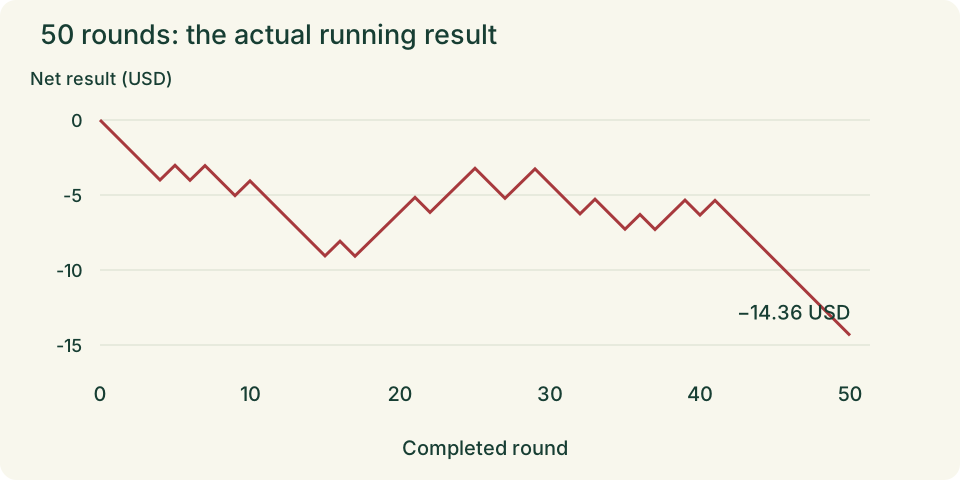
All 50 balance equations reconciled, and the demo history returned the same ordered stakes and payouts. We also checked the revealed seed hashes. Read how the game works and which fairness checks passed for the configuration and the limits of that verification.
1–2. A fixed step or a multiplier target
For a fixed-step exit, decide the count before placing the stake. In a practice exercise, “leave after three completed steps if the round survives” is precise. It does not mean “try three times after every crash,” and it does not mean “cash out at 3×.” A step count and a payout multiplier are different units. Changing difficulty can change what the same count means, so the mode belongs in the rule too.
The practical benefit is consistency: you are less likely to invent a new target just because the current round looks exciting. The limitation is that a step-count rule says nothing by itself about the money returned or the probability of reaching that step. You must read the actual ladder and rules. If the third step on your screen is not the multiplier in somebody else’s screenshot, their example does not describe your configuration.
A multiplier rule starts with the return instead. For example, take the first available return of at least 1.50×. On a ₱100 stake that target would return at least ₱150, for at least ₱50 net on a successful round. If the game does not offer exactly 1.50×, document the actual value at which you would stop. Never rewrite an offered 1.47× as 1.50× merely to make a table tidy.
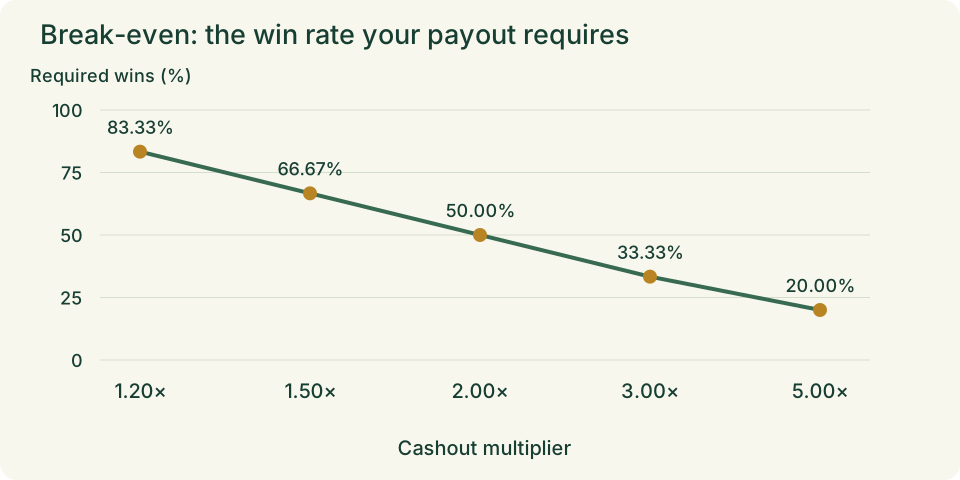
Early cashout needs frequent wins to offset losses. At 1.20×, five winning ₱100 bets earn ₱100 combined net; one losing ₱100 bet consumes all of it. At 1.50×, two wins offset one loss. At 2×, one win offsets one equal-sized loss. Those are break-even relationships, not claims that the game supplies the needed success rate. Larger targets can be harder to reach, so comparing only the successful return is incomplete.
A more adventurous target does not automatically create a better strategy. If a hypothetical 5× target wins one attempt in ten, ten ₱100 stakes cost ₱1,000 and the one return is ₱500. Net result: −₱500. A spectacular individual payout can coexist with a losing sequence. The relevant comparison is all returned value against all exposed stakes, with the same conditions and a clearly defined endpoint.
What would your cashout actually return?
A hypothetical peso example. This calculates a payout; it cannot predict a safe step.
Break-even is 1 ÷ multiplier for equal stakes and all-or-nothing losses. It is the required win rate, not the game’s actual chance of success.
3–5. Fixed stakes, bank percentages and capped doubling
A fixed stake is the easiest rule to audit. Choose an amount and keep it unchanged for the planned practice block. If every attempt costs 10 virtual credits, twenty completed attempts expose 200 credits in total. Add every payout and subtract 200 to obtain the result. A large win cannot obscure the denominator, and a loss does not automatically trigger a more expensive next attempt.
A fixed amount can still be too large for the bank. A ₱100 stake is 20% of a ₱500 balance. Five consecutive full losses would exhaust that balance. A ₱10 stake would allow fifty such losses arithmetically, provided the platform accepts that amount. This is not a recommendation to play fifty rounds: it shows how the same rule changes the number of opportunities to lose money. Check actual minimum stakes rather than assuming either amount is available.
A percentage rule adjusts the amount to the remaining bank. At an illustrative 2%, a ₱1,000 balance gives a ₱20 stake. After a full loss, the balance is ₱980 and the next exact 2% would be ₱19.60. A real client may accept only certain increments or impose a minimum. You must decide how rounding works before testing. If the minimum is ₱20, the calculated ₱19.60 is unavailable; continuing at ₱20 is no longer an exact 2% rule.
Percentage staking reduces the nominal amount after losses and increases it after growth. It does not change the payout rule or make a losing round more likely to win. Its practical use is describing exposure in relation to the current bank. Record both the planned fraction and the actual accepted stake, otherwise a tidy percentage chart may hide the platform’s constraints.
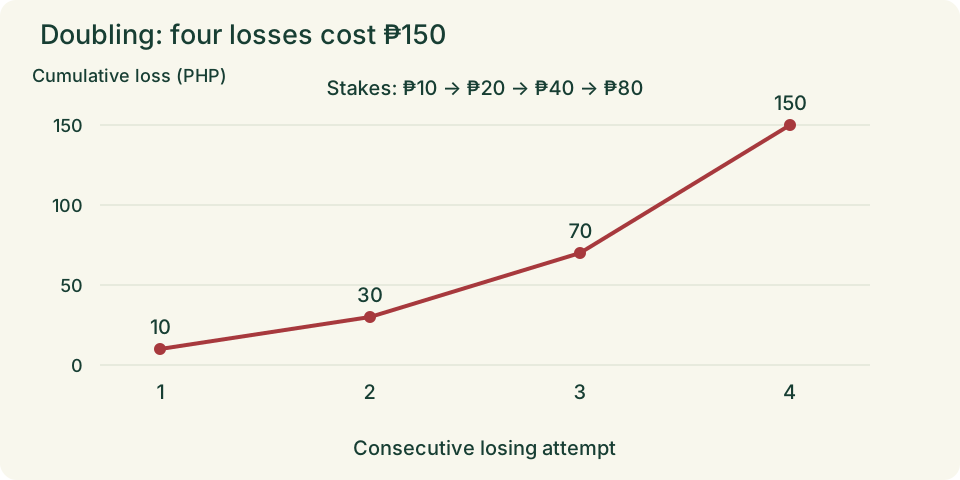
Capped doubling increases the next amount after a loss but refuses to exceed a chosen ceiling. Consider ₱10, ₱20, ₱40 and ₱80. Four losses cost ₱150. The next doubled stake would be ₱160. If your cap is ₱80, the progression must stop or reset according to the written rule. It cannot claim the recovery from a fifth bet that the cap would prohibit. Your bank and the client’s maximum stake can end the sequence even earlier.
The familiar recovery arithmetic also depends on the cashout multiplier. Lose ₱10, ₱20 and ₱40: you are down ₱70. An ₱80 win at 2× earns ₱80 net, giving +₱10 across the sequence. The same ₱80 win at 1.50× earns only ₱40 net, leaving −₱30. Doubling does not guarantee recovery at every cashout target. This difference is often missing from short “Martingale works” explanations.
| Attempt | Stake | Losses if all fail | Next doubled stake |
|---|---|---|---|
| 1 | ₱10 | −₱10 | ₱20 |
| 2 | ₱20 | −₱30 | ₱40 |
| 3 | ₱40 | −₱70 | ₱80 |
| 4 | ₱80 | −₱150 | ₱160 — above an ₱80 cap |
A cap limits the largest single commitment but also makes some losing sequences unrecoverable within the stated progression. That is the trade-off, not a bug to hide from the results. If you describe a capped system, report how often it stopped, how much had been lost at each stop and what happened after any restart. Restarting does not erase earlier losses.
6–7. Stop thresholds and fixed practice blocks
A stop-loss rule ends new attempts when the session’s net result reaches a chosen negative amount. A take-profit rule ends new attempts after a positive threshold. Define the bank and the starting point once. For a hypothetical ₱1,000 bank, a −₱100 stop and +₱100 target describe session boundaries. They do not guarantee that the final result lands exactly on either number.
Thresholds can be crossed between decisions. If you are down ₱90 and place a ₱20 stake, a loss ends at −₱110. A rule that forbids exceeding −₱100 must decline that next stake. A rule that checks only after settlement may allow the −₱110 result. Both can be described clearly, but they are different rules and must not share a misleading “maximum loss ₱100” label.
After a stop, continuing immediately under the label “new session” does not reset the total money lost. Keep a combined account of the whole practice block as well as individual sessions. A restart policy needs an explicit waiting condition, stake and new-session boundary. If somebody chooses the best restart points after seeing the history, that is fitting the past, not demonstrating a rule that could have been selected in advance.
For learning the controls, a fixed practice block is often more informative than chasing a positive ending. Set the number of demo attempts and an exit rule, retain every completed result and stop when the block ends. Ten rounds can reveal accounting mistakes or unclear controls. They cannot estimate rare outcomes reliably. Fifty rounds remain a small observation sample, not a dependable proof that a strategy has positive expectation.
If the client disconnects with a round unresolved, keep it separate until the game history resolves settlement. Do not count the click as a completed round or discard it because it makes the spreadsheet awkward. A complete ledger uses balance before, accepted stake, returned amount and balance after. The reconciliation is balance before − stake + return = balance after.
What about timing tricks, Reddit routines and predictors?
Player discussions include routines such as steady tapping, cashing out after ten jumps and taking a break every five rounds. They can produce a repeatable sequence of actions. The missing evidence is whether the rhythm or break changes the probability of success. A player remembering a winning stretch does not provide the losing stretches, exact version or a controlled comparison. We do not present those anecdotes as a discovered advantage.
Cashout also limits what you can learn from the history. If you stop at step three, you observe survival to step three and the settled payout. You do not observe where that same round would have ended had you continued. A replay that assigns a later crash point to every early-cashed-out round is inventing data unless the official protocol genuinely supplies and verifies that information. Our guide does not fill those gaps.
This matters when somebody claims one dataset proves ten different exit targets. Earlier targets may sometimes be evaluated from fully observed longer paths, subject to verified game semantics. Later targets cannot simply be recovered from short paths that were ended early. If comparisons use different sessions, their sample sizes and conditions must stay visible. A simulator based on assumed probabilities belongs in a separate, clearly labelled category.
A useful “how to win” answer therefore starts with the amount returned by a successful round and the cost of the failed attempts around it. You can win an individual round; you can also finish a chosen history in profit. Neither fact establishes a method that will profit on the next history. Use the calculator to understand the rule, the illustrated rules to identify the controls, and the official demo access page for current practice availability.
Chicken Road: quick answers
What is the best Chicken Road strategy?
No guaranteed winning rule is established here. A useful rule specifies the edition, difficulty, stake, exit and stop condition. Compare complete results and limits, not just the biggest payout.
Can I win every time by cashing out early?
No. An early target still needs to be reached, and a full lost stake can outweigh several small winning-round profits.
Does a predictor know the next safe step?
We have no verified predictor. A calculator can describe a chosen payout and exposure; it does not see the next game outcome.
Are these seven rules tested on live Chicken Road rounds?
One rule was actually played for 50 rounds: Medium, 1 USD stake, five-step exit. Earlier exits are retrospective calculations on those paths; the other examples illustrate arithmetic.